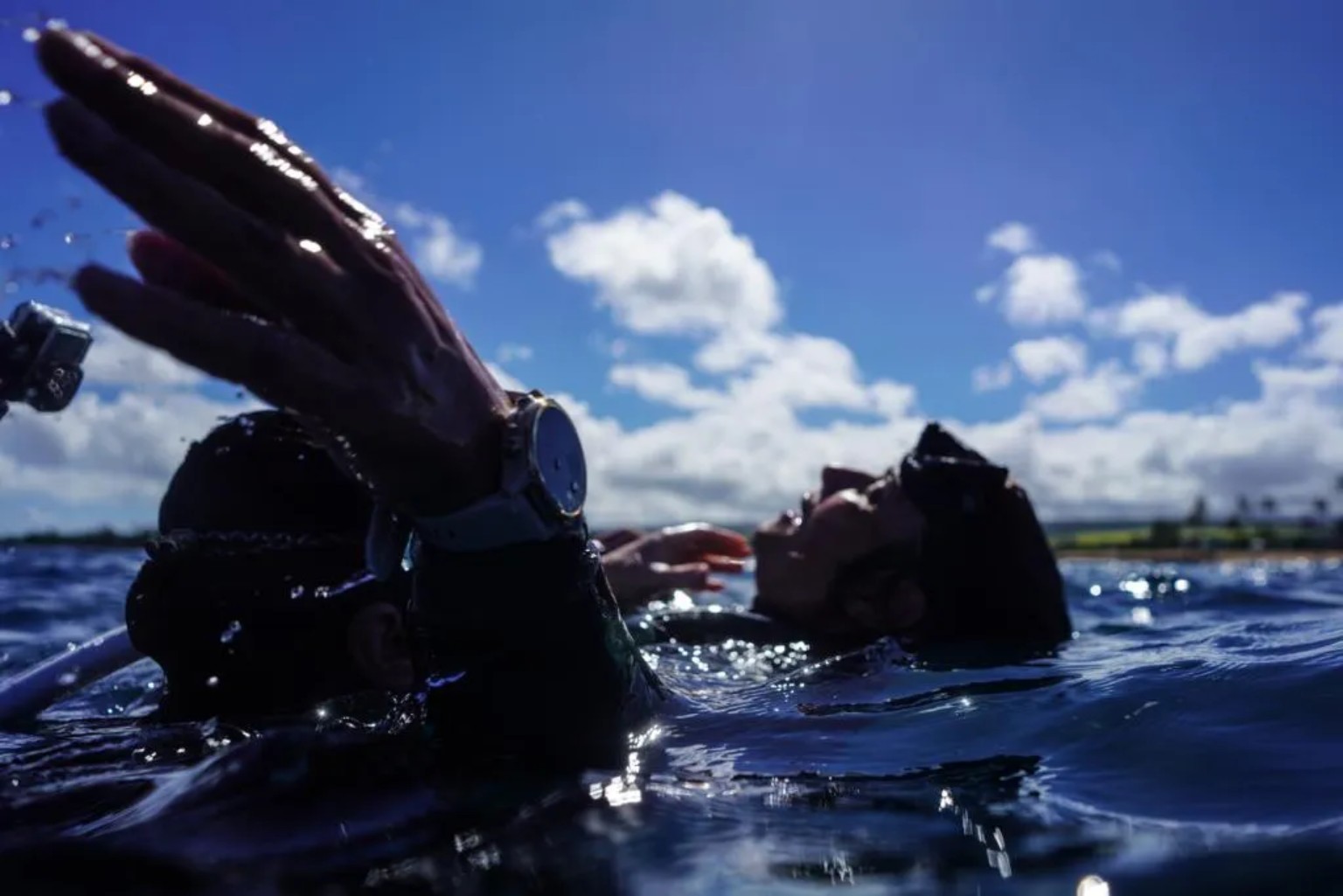
An ancient reflex may be key to restoring calm and rewiring our stress responses.
This is Part 2 of a four-part series exploring insights from my observational study on 120 freedivers and nervous system adaptation. In Part 1, we introduced freediving as a mirror — one that reflects back the hidden patterns of breath, state, and survival that many of us carry.
But what makes that mirror so powerful isn’t just the stillness of the ocean — it’s a built-in reflex. An ancient one.
Before breathwork became popular or somatic therapy had a name, your body already knew how to shift state. To conserve energy. To come home to calm.
It’s called the Mammalian Dive Response (MDR) — a reflex hardwired into the autonomic nervous system. When your face is submerged in water, your body slows your heart rate, constricts blood vessels in the extremities, and sends oxygen-rich blood to vital organs. Originally designed as a survival mechanism to protect us from drowning, the MDR does something else too:
It creates a parasympathetic shift — one that opens the door to regulation, clarity, and presence.
And while the MDR helps conserve oxygen and protect the brain under pressure, it also becomes something more, and science shows that when used intentionally, the MDR is:
An anchor point to your nervous system. A repeatable pathway into calm. And, a reflex that can be trained, reengaged, and consciously harnessed — both in the water and out.
You’ve likely felt aspects of this before, even if you’ve never stepped into the sea.
Have you ever:
- Walked into a room and instantly sensed tension you couldn’t explain?
- Held your breath during a difficult conversation?
- Felt calm — not because the world was quiet, but because you were?
That moment — that internal shift — is your nervous system listening.
Or, maybe you’ve felt it mid-run, when your breath and body lock into rhythm. Or in the silence after a yoga pose. Or at sunrise — coffee in hand, the world not quite awake.
These are moments when your nervous system softens — when everything aligns, even for a breath.
Now imagine that happening underwater… magnified.
For many, freediving is the first time they hear the voice of their own nervous system. Because in the water, there are no phones. No playlists. No conversations. Just your body. Your breath. And the quiet truth of how you’re really doing.
These responses aren’t just about freediving.
They’re about the nervous system’s remarkable ability to adapt — to stress, to stillness, to connection.
And they point to three mechanisms that showed up over and over again in our study:
- Exposure-based adaptation, or learning to face discomfort with presence instead of avoidance
- Somatic awareness, the ability to notice and respond to body cues like blink rate, heart rate, and tension
- Co-regulation, the quiet influence of a calm nervous system in the presence of another
Together, they form a foundation for recovery, resilience, and reconnection. Recovery from adverse events, substance use concerns, relational trauma after-affects, and the stress of living in today’s current world state.
And at the heart of all three is something called interoception — your nervous system’s ability to sense and interpret internal signals. It’s how you know your breath is shallow, your pulse is rising, or that the tone of someone’s voice is putting you at ease.
Interoception is how the body speaks to itself. Freediving just turns up the volume.
“I didn’t know it at the time, but the water was teaching me how to regulate.”
— Participant 17
You don’t need to freedive to feel it. You just need to notice:
- When a pause becomes permission to breathe again.
- When cold water grazes your skin and the world sharpens into focus.
- When stillness doesn’t feel lonely — it feels like home.
The MDR is part of your body’s original blueprint for nervous system recovery. And for freedivers, it’s not just awakened — it’s practiced.
Over and over, until it becomes familiar. Reliable. A tool not just for depth or exploring underwater— but for daily life. For engaging your nervous system for flexibility, responsiveness in real time, and finally, what so many of us seek from coping strategies, a way to navigate life just a bit — easier.
What Freedivers Are Teaching Us
That this isn’t just about freediving.
It’s about what happens when we get quiet enough, still enough, present enough to notice the nervous system patterns shaped by pressure — internally and externally.
Our study gathered 71 in-depth responses focused on fear, anxiety, and the emotional challenges of breath-hold diving. These weren’t surface-level thoughts.
They were lived, embodied accounts of how stress shows up — and what it takes to meet it.
The themes that emerged were raw and deeply human:
- “Panic starts to rise in my throat the moment I start the breathe-up because I know what comes next.” — Participant 22
- “I used to dissociate mid-dive and only realize it when I surfaced.” — Participant 39
- “My breath-hold felt amazing one day and horrible the next. I didn’t understand why.” — Participant 10
What the water revealed often mirrored what many experience on land: A nervous system constantly scanning for safety — often without conscious awareness.
But here’s the difference —
In the water, there are no distractions.
No multitasking.
No easy way to override what’s happening in your body.
Just breath.
Just sensation.
Just the truth of your current state.
Freediving strips away the noise and shows us what’s already there.
And in doing so, it reminds us: the nervous system is adaptable.
We don’t have to be stuck in the same loops. There are ways to meet stress differently — and slowly, breath by breath, reclaim a sense of choice.
Patterns of Adaptation
Every freediver enters the water with more than just their gear. They bring their history, habits, and hidden survival strategies.
Some hold tension in their jaw. Some control their exhale too tightly. Some smile and nod, even when something feels off.
These aren’t mistakes — they’re patterns of protection shaped by experience. Ways the nervous system learned to protect us. And in freediving, those adaptations show up in startling clarity.
- “I didn’t realize how much I needed people to think I was okay — even when I wasn’t.” — Participant 12
- “The dive wasn’t hard physically. It was the loop in my head saying I’d mess it up.” — Participant 45
- “Although I rarely felt panicky during dives — other than when I first started — I often find it difficult to be completely relaxed. The anticipation of failure, injury, or discomfort intensifies those sensations. And the mental stress? It messes with my equalization and technique, which only increases the chance of failing a dive or getting hurt. It becomes a negative reinforcing loop.” — Participant 55
Substitute any life situation in those responses, and you will see your nervous system at work.
In the study, one of the most striking findings was how often divers misread their own state — how the internal perception of safety didn’t always match the body’s actual signals. This mismatch can lead to early turns, missed cues of connection, or post-dive dysregulation. How do these same patterns show up in day-to-day life?
This is what we call perceptual inaccuracy — when the story running inside your head overrides the signals from your body. It’s not a flaw; it’s a pattern shaped by past experiences, sometimes long before freediving ever entered the picture.
But here’s where it gets hopeful.
Freediving doesn’t just reveal these patterns—it gives us the opportunity to rewrite them. Even more powerfully, incorporating the mindsets and physiological experiences from diving into daily life can lead to meaningful shifts in how we relate to stress. For some, this awareness is the medicine that allows recovery to begin.
And here’s where the mammalian dive response returns — not just as a freediving reflex, but as a tool available to all of us.
Through gentle breath holds, cold water immersion, or even applying an ice pack to the face for 30–45 seconds while breathing normally (repeating this 2–3 times), we can consciously engage this ancient pathway. This allows the body to soften, shift, and build tolerance — not just in the ocean, but at home, before a meeting, or after a triggering moment.
This is how we can use the dive response as a supportive framework — intentionally engaging it to promote recovery and strengthen the nervous system’s adaptability over time. Recent research studies highlight that intentional use of the MDR points to improvements in trauma recovery and vagus nerve modulation.
Through repetition, breath-hold, recovery, and feedback from the water itself, divers begin to reshape their internal maps. What once felt threatening starts to feel tolerable. What once triggered shutdown starts to feel like expansion.
- “It’s strange. The more I let myself feel what’s happening, the less it controls me.” — Participant 8
- “If I breathe into thoughtlessness, and try to be present in my body but also sit with the discomfort, it makes the dive better.” — Participant 88
Co-Regulation in the Water
Recovering from adverse experiences isn’t a solitary act — and neither is freediving.
This next section captures one of the most powerful aspects of healing: connection—or, just as significantly, the absence of it. Co-regulation—the way we find safety through others—isn’t just a concept in trauma recovery. It’s a physiological necessity in all areas of life.
Whether on a line or in open water, the presence of a safety diver, instructor, or buddy often determines not just the logistics — but the physiological and psychological safety of a dive. How does this play out in day-to-day life?
Research highlights that social connectedness plays a critical role in nervous system regulation, reducing threat responses and promoting both mental and physical well-being. Engaging in shared activities like freediving creates a sense of mutual trust, reinforcing self-regulation through co-regulation.
Instructors and dive buddies play a pivotal role in shaping this experience — when they model calmness, attunement, and presence, they create an environment where a diver’s nervous system can shift into a state of safety. This allows for greater relaxation, emotional resilience, and physiological efficiency in the water.
- “Freediving has taught me how to regulate my nervous system. The more I practice relaxation before a dive, the more I notice that my body automatically shifts into a calmer state without me having to think about it, especially when I have confidence in my dive buddy.” — Participant 19
But this same social connection can also highlight its absence.
In our study, 49% of freedivers reported that the community aspect was crucial to their mental health. But for others, social dynamics created stress rather than relief — concerns about performance, comparison, or being a burden.
- “I push myself harder when I’m diving with people I admire — even when my body is telling me to stop.” — Participant 50
- “I expected freediving to help me feel connected, but sometimes, it makes me feel more alone.” — Participant 36
Fostering psychological safety in relationships isn’t just about being surrounded by others—it’s about cultivating an environment where we feel seen, supported, and able to regulate our nervous systems effectively. We see this pattern reflected in therapy rooms, yoga classes, and other sports that act as pathways to recovery.
So What Happens Next?
What do you do once you’ve felt the patterns rise to the surface —
when the water or daily life shows you both the tension you carry
and the calm that’s still possible?
This is where experience begins to shape understanding.
Where insight becomes integration.
And where regulation — real, embodied, and lasting — starts to feel within reach.
Whether you’re in the water or on land, Part 3 explores how the mammalian dive response can support trauma recovery, expand nervous system flexibility, and gently reshape the way we meet stress — not just as a moment of relief, but as a repeatable access point to self-regulation.
We’ll explore:
- How graded exposure, self-concept, and community support create lasting nervous system change
- Why the MDR supports deeper emotional processing — even in people with high levels of stress
- And how we can use this in a structured way to work with the vagus nerve — whether or not you ever put on a mask or fins
This is the continuation of my original observational study. And Part 3 is where we translate these findings into practices you can carry with you.
Not just for divers.
For anyone ready to meet their nervous system with intention.
This article is for educational and informational purposes only and is not a substitute for medical or mental health advice. If you try cold face immersion and breath holding, please seek out proper guidance.
Freediving should always be practiced with proper training, safety measures, and supervision. Never dive alone.
A note from Elaine:
This work has lived inside me for years — shaped by dives, clients, research, and lived experience. Writing it and sharing it here is both a release and a reminder:
That you’re not alone in what your body remembers.
That even something ancient in your nervous system can hold wisdom.
And that sometimes, the way forward starts with a single breath.
Thank you for reading. Part 3 is coming soon.
— Elaine