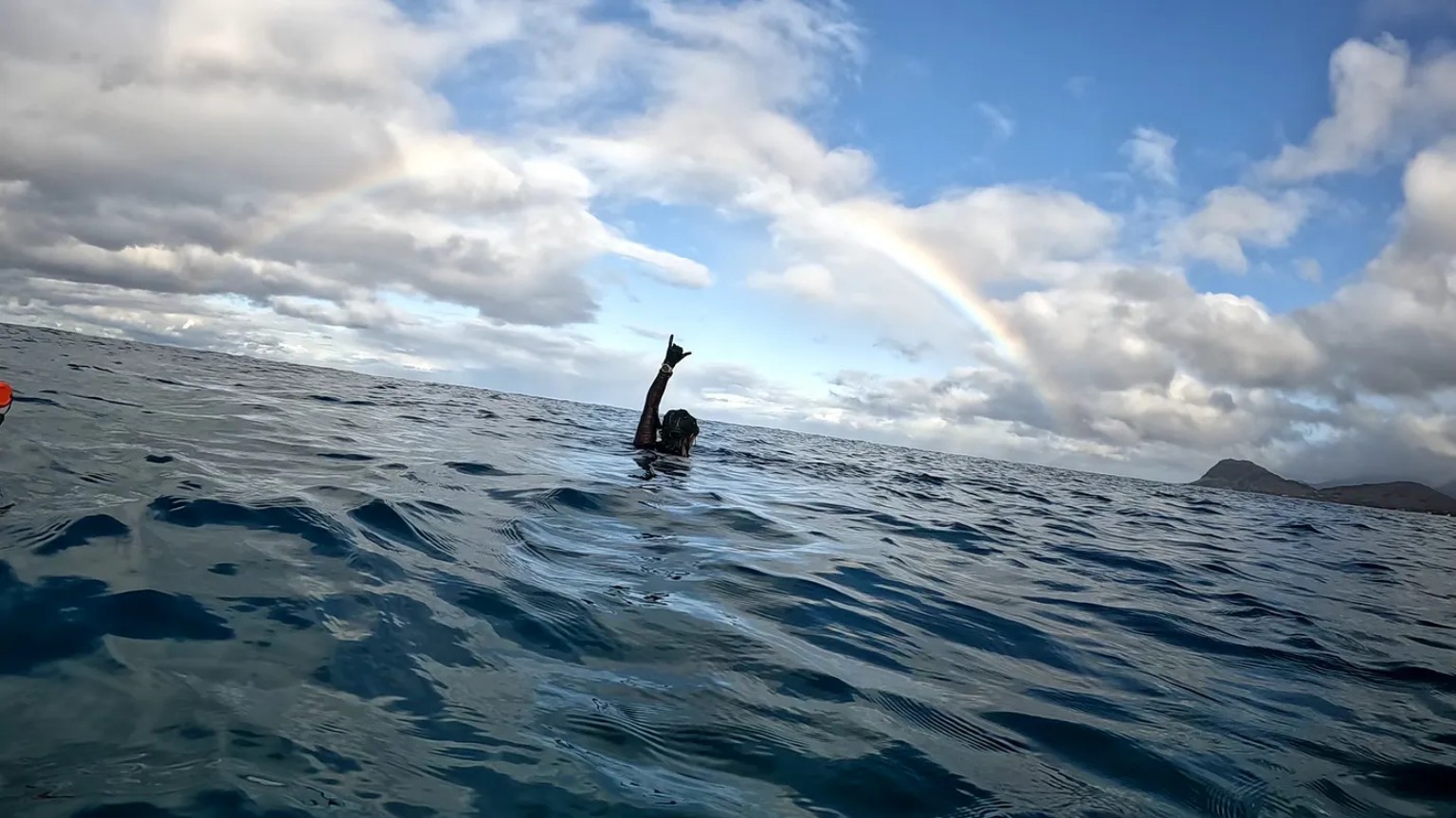
This is Part 3 of a 4-part series on trauma-informed freediving and the nervous system. In this installment, we explore how we mask dysregulation, how breath reveals our nervous system patterns, and why learning to stay with discomfort may be the key to lasting change. I share my clinical perspective as a licensed clinical social worker, research psychologist, and freedive instructor.
Missed the first two parts? Start with Part 1 and Part 2.
What happens when your breath becomes the only place left to listen?
For some of us, that moment — the shift from breath to awareness — is where everything starts to change.
When stillness feels unsafe, we need more than coping strategies or to simply relax. We end up performing “calm” or “stillness.” But calm doesn’t always equal safety — and the body knows the difference.
This is where freediving offers unexpected insight. In this piece, we’ll explore more about how trauma responses mask unease and reflect deeper survival strategies. Strategies rooted in keeping the peace. We will look at:
- Why the Mammalian Dive Response (MDR) supports deeper emotional processing, but only when paired with the right tools.
- How the breath becomes a gateway to your nervous system — even outside of breath-hold situations.
- And how this entire system works — even if you never wear a wetsuit or hold your breath underwater.
When Staying Calm Is a Job
Sometimes, staying calm feels like a full-time performance.
You keep your voice even. Your body still. Your reactions measured.
But inside, something doesn’t match.
Your system is working overtime to hold it together —
and no one sees the cost.
Because the calm you’re showing?
It’s being managed, not lived.
And that’s the moment things start to crack —
when the nervous system finally whispers:
“This isn’t regulation. This is effort.” This is how we survived.
There’s a moment in the movement — it’s not always dramatic or dangerous, but it’s quiet — when something in your system says no.
It can stop you in your tracks. Or mid-dive.
Suddenly, it’s not just a job — it’s your nervous system on display.
Your body tightens. Your focus slips. A flicker of doubt or disconnection rolls in.
And even if you’re doing everything “right,” it doesn’t feel right.
It can happen in the middle of a freedive.
Or a run.
A golf swing.
Right before a yoga pose.
That pause before a leg press.
The gasp during a lap swim.
It’s not pain, per se — not the kind you rate on a scale from one to ten.
It’s something else.
Unease.
This is where freediving taught me that when the MDR steps in —
sometimes it helps, and it sometimes hides.
The Physiological Pause
The Mammalian Dive Response (MDR) doesn’t just slow you down — it creates a window.
In Part 2, we discussed the MDR as the primal safety mechanism to save you from drowning. In freediving, we leverage this to help us withstand pressure underwater, conserve oxygen, and find physiological calm. In other words, dive longer, stronger, and for some — deeper. We also discussed how you can use it as part of your recovery process — out of the water.
However, the MDR becomes more than that when we interact with it intentionally.
It’s a brief physiological pause where the nervous system can finally begin to process what stress has pushed aside.
Not through willpower.
But through state change.
It gives space. And relief. Without asking you to think your way there.
But sometimes that pause — the in-between — creates static in the background. It can feel like fog in the brain, tension in the belly, or a restless urge to do something — anything — just to feel in control again.
A kind of not-quite-here feeling. A gap between what your body knows and what your mind insists you push through.
Many people find this uncomfortable. Without the words to articulate it, they begin overthinking — trying to figure it out, explain it, fix it, or even say, “This is all in my head.” Maybe the people you were diving with agreed with you, or your doctor, best friend, or therapist.
You might hear, “You just need to relax.” But here’s the thing: your body is in a physiological state of calm — and your brain still won’t settle.
Hate to break it to you — but yeah, it is in your head.
They were right all along… just not in the way you think.
Because your nervous system starts in your head.
The Command Center: It’s Not Just the Vagus Nerve
It starts with twelve cranial nerves — a network of direct communication lines between the brain and body.
We often talk about the vagus nerve, and for good reason: it’s the main highway of the parasympathetic nervous system (rest and digest). But the vagus doesn’t work alone. The other eleven cranial nerves contribute to:
- Facial expression
- Eye movement
- Sound processing
- Swallowing and balance
In freediving, they’re not just passive — they’re essential. They’re actively contributing to pressure adaptation, equalization, orientation, and the moment-to-moment feedback that helps us feel stable and safe underwater. They also help trigger the dive response. (See Part 2 for more on this.)
And in life and trauma recovery, they help us scan for danger, detect tone, or soften when we sense safety. It’s the moment your eyes lock onto a stranger’s face for warmth, or when your body exhales because someone’s tone tells you it’s okay — and says “I’ve got you.” Sometimes we need another nervous system to show us the way back — someone calm enough to lend us theirs, even briefly. This is how our cranial nerves work seamlessly.
These nerves don’t just help us survive.
They help us connect.
And when you begin to train these systems — especially your breath — you’re not just working your lungs.
You’re speaking directly to your nervous system.
And when trained well, your system learns to say:
“We’re safe. We can stay.”
That’s not mindset.
That’s neurophysiology.
The Mirror of the Dive: A Feedback System for Your Nervous System
Freediving doesn’t just reveal your physical limits.
It reveals your patterned responses to pressure.
In my observational study, 120 divers reported a wide range of emotional states that mirrored their life experiences, but with one key difference:
In the water, there’s nowhere to hide.
“Early turns despite feeling physically capable” — Participant #32
“Difficulty equalizing or focusing under pressure” — Participant #18
“Racing thoughts or blank dissociation before descent” — Participant #74
“Negative self-talk afterward” — Participant #118
“An urgent need to ‘prove something’ even in calm conditions” — Participant #101
These weren’t random dive days.
They were expressions of the same unease that had gone unspoken on land.
The Body Is the Map
When we see unease or reactivity in the water, we’re often seeing:
- Neuroceptive mismatch (perceiving threat despite safety — like hitting the brakes when the road looks clear, or an early turn on the dive)
- Incomplete regulation (still stuck in performance or fawn — sounds like “My breath-hold sucks today,” or “I can’t equalize.”)
- Post-stress vulnerability (emotional charge not yet integrated — like diving in frigid waters with no wetsuit, or walking through the world with no emotional skin on)
- Ambivalence (caught between freeze and flight — should I stay or should I go?)
The MDR can mask this with calm.
Without co-regulation and interoceptive awareness, it becomes a Band-Aid — not a bridge.
Because here’s the thing:
The MDR gives you access to calm — but it doesn’t teach you what to do with it.
Remember, it’s an ancient survival mechanism.
For many people, especially those with trauma histories, this type of calm isn’t neutral. It’s confusing. Disorienting. Sometimes even threatening.
If your body learned that stillness meant danger —
if the quiet in the room was when things went bad —
if relaxing meant letting your guard down and getting hurt —
then the calm induced by the MDR doesn’t feel safe.
This is the mismatch.
Your physiology is saying, “You’re relaxed.”
Your nervous system is saying, “We’re not safe.” It feels like a trap. Because once, the stillness was when the worst happened.
And so you sabotage the dive (or any other performance in life).
Or your mind races. Or you abandon the moment — not because you’re weak, but because you were never taught what safe calm feels like. But you continue to perform it.
This is why unease shows up even in perfect conditions.
Why people shake, cry, or turn early on a dive that felt physically fine.
Because the body doesn’t trust this process — yet.
And without a new map, it won’t.
The CO₂ Mirror: From Tolerance to Adaptation
CO₂ — carbon dioxide — is a natural byproduct of cellular metabolism. As we hold our breath or exert ourselves physically, CO₂ levels begin to rise in the bloodstream. This triggers the urge to breathe, a key part of both survival and emotional regulation. This is a landmark on that body map.
But CO₂ isn’t just a chemical signal or landmark. It’s a mirror of your nervous system’s adaptability. Freediver or not.
CO₂ shows you how you respond under pressure —not just physically, but emotionally and neurologically. You might feel it as a tightness in your chest, a wave of heat across your face, or a quickening of thoughts before the next inhale.
It reflects whether you’re bracing, overriding, collapsing, or connected.
But in freediving and in day-to-day life, the goal isn’t just CO₂ tolerance because tolerance implies suffering.
You might feel it as tension in the gut.
A touch of breathlessness.
That low-grade buzz of anxiety in your belly.
Or a sudden urge to move, speak, flee, or fix — even when there’s nothing to escape.
These are signs of CO₂ speaking.
But here’s where we’ve been getting wrong: In the dive space, we keep calling it CO₂ tolerance. As if the goal is to just endure it.
But tolerance implies you have no choice. That you’re simply putting up with something unpleasant. Like tolerating traffic. Or bad behavior. Or emotional pain you can’t fix.
Both my research and my clinical experience confirm that the divers who showed the greatest transformation weren’t just tolerating CO₂. They were adapting. That’s the nervous system learning a new response.
To recognize distress, stay with it, and allow their system to reinterpret it — not as danger, but as data. That’s not tolerance. That’s neuroplasticity in motion.
The moment we start to rewrite the program: “my breath and calm doesn’t have to mean what it used to.”
So, what if CO₂ could be a signal — not a threat?
In my clinical work, I see this every time we learn to breathe into calm. We stop the performance and begin the adaptation. In the dive space, that is where the key opens the door. That’s when the dive finally becomes safe. In trauma recovery this is the turning point.
That’s the moment regulation becomes embodied. Adaptation isn’t about getting rid of the urge — it’s about learning how to stay with it.
From Adaptation to Relief: How Breath Rebuilds Regulation
Once divers (and the patients I work with) began to adapt to their CO₂ response, rather than endure it, everything changed.
They didn’t just report longer breath-holds or better dives, or reduced symptoms.
They reported greater ease in their daily lives, less reactivity, and more access to calm, and better breathing. Essentially, opting in to the experience and the ability to recognize internal shifts before they spiral.
“Learning to identify the urge to breathe — and working to move past the discomfort has changed how I relate to stress” — Participant #51
“There’s a sense of mental activation that makes it hard to fully enter the freediving mindset.” — Participant #58
Another turning point — where breath becomes more than a technique.
It becomes a physiological anchor for body awareness and self-regulation.
And we’re not just seeing this in anecdotal reports.
A 2022 study working with individuals with post-traumatic stress disorder found that CO₂ exposure — delivered in a controlled, structured breath training format — dramatically reduced symptoms of post-traumatic stress disorder and autonomic hyperactivity within 28 days.
Participants weren’t just feeling better. They were recalibrating their nervous systems.
Over 70% showed major reductions in stress reactivity, medication reliance, and emotional dysregulation (Cuyler et al., 2022).
These same patterns are in my study.
“I’m afraid of complete failure during diving.” — Participant #67
And yet, in the same breath, they described:
“But there’s this sense of peace when I’m in the moment…It’s a way to disconnect and reset myself, and that is why I keep coming back.”
This is the paradox many divers and trauma survivors live inside.
Freediving both reveals the stress we carry — and offers us a way to release it.
It’s not always dramatic or immediate.
For some, the changes are subtle but steady.
“I feel content after I dive… It’s like I’m just more okay being in my own skin.” — Participant #27
“The calm lasts all day. Even lactic acid doesn’t hit the same.” — Participant #97,
That’s the quiet magic of gradual exposure.
The nervous system doesn’t just endure CO₂ buildup or physical challenge.
It begins to rewrite what pressure means — emotionally and physiologically.
It’s the body learning a new way to relate to breath, pressure, and internal sensation (interoception). It’s a way to stop performing and simply become. Even if only for the duration of the dive or just the moments after, but this carries over.
“After learning to sit with the urge to breathe, I noticed I could sit with other hard things too. Like emotions. Conversations. Silence.” —Participant #101
Because when you can stay present with your own breath under stress —
When you can meet CO₂ not with fear, but with familiarity —
You begin to shift how you meet everything else.
This is the continuation of what I saw in the data—and what the research is beginning to confirm. Slow, intentional exposure to discomfort doesn’t just build mental grit. It engages the vagus nerve, reshapes our response to stress, and gives us access to regulation we can actually feel.
And it’s not just for freedivers. You don’t need to hold your breath at 5, 10, 15, or even 20 meters to work with your nervous system. You just need to notice what happens when you meet your breath with intention.
Can you listen?
Can you breathe better? Do you know when you are holding your breath without awareness?
This is the work.
Not to escape discomfort.
But to relate to it differently, so that regulation becomes a capacity, not a performance.
A Final Word, and a Way Forward
This is where performance ends — not in collapse, but in coherence.
Where the breath becomes the bridge. Where you stop managing yourself and start inhabiting yourself.
In the final piece of this series, I’ll share:
What it looks like to actually live this.
To move from performance into presence.
From urgency into trust.
To rebuild a relationship with your body that isn’t built on survival.
Whether or not you ever hold your breath underwater — your body is already speaking.
You just need to pause long enough to listen. Part 4 will drop soon. Follow to stay updated.
If this resonated with you, you can find the full series, upcoming workshops, and more trauma-informed freediving resources on my Linktree. I’m currently building a community around this work — divers, facilitators, and anyone ready to meet their nervous system with more compassion are welcome.
Note: Breath-holding should always be practiced with proper safety protocols, especially outside of water. Freediving should always be in the company of a dive buddy, never dive or train alone.
Reference: Cuyler, R. N., Katdare, R., Thomas, S., & Telch, M. J. (2022). Real-world outcomes of an innovative digital therapeutic for treatment of panic disorder and PTSD: A 1,500 patient effectiveness study. Frontiers in Digital Health, 4, 976001. https://doi.org/10.3389/fdgth.2022.976001