TL;DR — What This Article Offers
This piece explores how freediving supports nervous system recovery — not just through technique, but through physiology, presence, and connection.
Blending lived experience from over 120 freedivers with somatic science, it maps the path from dysregulation to integration.
You’ll learn how breath and safety protocols become both metaphor and mechanism for adaptation — what some might call trauma healing.
Whether you’re a diver or simply learning how to stay with yourself in hard moments, this is a nervous system guide for feeling safe again — in the water, and in your own body.
What Recovery Looks Like Now
Over the last three articles, we’ve briefly explored what trauma looks like. How it moves, how it hides, and how it shapes us. We named three core mechanisms necessary for healing: the physiological pause, interoceptive awareness, and adaptive integration. We talked about how the mammalian dive response (MDR) offers a unique entry point: a pause long enough to begin coming home to your body. We witnessed how, for many freedivers, breath-holding became an unintentional entry into recovery. (If you have not yet read the first three, check here) We learned that the line between trauma, tension, stress and breath is a fine one and worth a deeper exploration.
Now we ask — what happens next? What does it actually look like to live with a body that no longer performs to survive, but lives?
First, Naming the Pattern
Let’s be clear: trauma physiology isn’t always loud. It isn’t just the hypervigilance, the anger, the drive. Sometimes it’s the shutdown. The withdrawal. The moments when you’re not fighting the world…you’re just too tired to show up.
It’s the accumulation of breaths never taken. Of moments where you weren’t seen, heard, or held. It’s what happens when you’re told, over and over, to let it go. Move on. Don’t rattle the cage. Don’t stir the snakes.
But you can’t just forget the ache of being unmet. And so all of it gets stored, ever so quietly, somatically, inside. It shapes how you respond to stress. To noise. To traffic. To delays. To the mundane chaos of modern life. To the breath-hold and everything it brings back with it. To the space between therapy appointments — or a dive session.
Trauma in the Everyday
This is how trauma (or stress) physiology shows up:
- The tension in your voice when you’re interrupted.
- The edge that rises when someone cuts you off.
- The need to control your environment or let it fall apart.
- The way you brace when things don’t go to plan.
- The shutdown when it’s too much.
- The way you can’t catch your breath.
- The tears that are hot in your throat that make you feel like you are choking.
- The way sadness slows you down.
What the Body Reveals Below the Surface
In freediving, trauma physiology doesn’t always announce itself with panic or anxiety. Sometimes it shows up in subtle, patterned ways — your body telling a story before you can name it.
Here are four of the most common signs:
- Uncomfortable CO₂ adaptation despite training: your system misreads the natural rise in carbon dioxide as danger, every single time you hold your breath.
- Dissociation or fogginess: feeling checked out, spacey, or confused before, during, or after the dive. Like being on autopilot.
- Early turns or propulsion breakdown: your body aborts the dive even when it's technically safe, often due to low energy, fear, or system overload. You can’t hide from your nervous system underwater.
- Talking right after surfacing / skipping protocol: a missed pause that can signal survival-mode reentry instead of regulated return.
Other signs to watch for:
- Shallow or insufficient breathe-up
- Super low heart rate or inability to recover quickly
- Loss of equalization
- The inner script: “My breath hold sucks today.”
These aren’t just performance issues. They’re patterns of nervous system dysregulation — each one a breadcrumb leading you back to the deeper work.
This is the residue of long-term dysregulation. A nervous system that has lost its buffer. That doesn’t have the tools — or space — to regulate without reaching for something: a binge, caffeine, anger, judgment, another relationship, music, nicotine (and other substances), your phone, a shopping cart, another breath-hold, another dive.
“Freediving allows me to escape from what is a pretty stressful life situation. I’m definitely addicted to CO₂ and hypoxia ‘highs.’ I appreciate the escape apnea diving gives me, but I also sometimes worry this kind of escape is not so different from substance abuse.” Participant #67
But even when the dive becomes another escape, the body still remembers what it feels like to settle. And that’s where recovery begins — not in perfect control, but in learning how to stay.
Two Truths and A Lie
As one diver shared:
“It almost feels as if freediving washes away my depression. My irritability is gone… I’m not as critical on myself and barely (if at all) engage in self-hate thoughts.” Participant #18
So what does it look like when recovery begins?
A nervous system in recovery begins to recognize potential disruption. It creates just enough space to opt in — or opt out — of reacting.
This system can pause.
Not forever, but maybe for 5 more seconds. Maybe 10. Maybe 2 minutes.
It’s a physiology that can hold two truths and not crumble or rage.
It’s no longer compelled to dive just to feel alive.
Maybe now, recovery looks like one less snack.
One less binge or purge cycle.
Turning down the next drink.
Stepping away from the phone.
Staying home to sleep.
And perhaps — being still.
This is what we’re now calling a regulated nervous system — one that can hold two truths at once and still function. It doesn’t collapse under pressure or believe that dysregulation is all it knows.
And the impact shows up beyond the water.
In my study of 120 freedivers, 85% of participants reported improved self-concept — describing increased confidence, self-awareness, and resilience.
It doesn’t mean you’re always calm. It means you can be. And let’s be honest — do we always need to be calm? Or do we need to feel capable within whatever state we’re in? Perhaps a nervous system that can experience a range of emotions and maintain attention, focus, presence, and gain an enhanced awareness of their body.
It means you’ve learned how to access your eighth superpower: interoception — the ability to sense your inner world.
And once you can track what’s happening inside, you stop outsourcing your safety. You stop relying on the next trip, the next breath-hold, the next breakthrough.
You begin to feel at home.
Interoception is the quiet tracking of inner signals — what’s happening in your body, moment by moment. It’s the pause before the emotion. The flicker of sensation that tells you your heart rate is shifting, your breath is shortening, or your gut is bracing. Most people never learn how to listen to this.
But freediving makes it impossible to ignore. When you’re underwater, stripped of language and external cues, interoception becomes your compass.
And as you get better at listening, you start to map your own nervous system. You learn the difference between effort and force. Between calm and collapse. Between holding your breath to prove something — and holding it to meet yourself.
Interoception: Your Inner Dive Watch
Interoception is the body’s internal GPS. It tells us when we’re hungry, tired, stressed, or safe. But for many people, especially those navigating anxiety, depression, or living in high-stress physiological states, the system gets distorted.
In anxiety, interoception becomes too loud. The heartbeat speeds up, and the body interprets it as danger. In day-to-day life, this might look like spiraling thoughts, hypervigilance, or an inability to distinguish between discomfort and danger.
In therapy, it often shows up as difficulty staying present. We may interpret bodily sensations like a racing heart or tight chest as emergencies instead of signals.
In freediving, this can show up as tension or anxiety, “feeling itchy”, during a breath-hold or misreading CO₂ buildup as a threat.
In depression, it goes quiet. Signals are harder to feel. Emotional numbness, disconnection, and blunted awareness take hold. In day-to-day life, this can look like low motivation, indecision, or a flat affect — when even hunger or fatigue fails to register.
In therapy, it can manifest as a muted emotional range or a struggle to describe any felt experience in the body at all.
In freediving, this might appear as apathy toward safety cues or disconnection from bodily sensation during a dive.
Both extremes interfere with self-regulation. You either feel too much and can’t trust it, or too little and can’t access it. But here’s where freediving becomes a quiet revolution: it trains interoception without even meaning to.
The MDR gives us access to a physiological calm state that’s hard to reach on land sometimes without a lot of work. By that, I mean things like breathwork, vagus nerve devices, medication, and other methods.
From that MDR-induced calm, we begin to notice subtle shifts: blink rate, swallow frequency, breath rhythm, and areas of tension or release. That listening becomes the foundation of interoceptive recalibration.
Among experienced freedivers (4+ years), 89% said this practice helped them manage daily stress more effectively — pointing to long-term nervous system adaptation.
Try it now. Are you breathing? Are you blinking or intently focused right now, reading? Drop your shoulders. Take a breath and let it slowly release. Simple, right? This is interoception.
It’s a repeated, embodied practice of navigating physiological stress (or no energy at all) while staying present. And over time, it changes how people interpret internal signals — reducing reactivity, increasing self-trust, and building regulation from the inside out.
The Embodied Shift
This is the key to beginning the integration process. When the body shifts from a stress physiology to one that’s flexible, grounded, and adaptive, we gain something critical: choice. And data. We get a wealth of data points to work with, to take and process somewhere safe, or we take note and — shift.
In this state, we’re not just reacting — we’re responding. Day-to-day, that looks like accessing just enough energy to meet the moment, without overwhelm or collapse. That’s the real superpower.
And it works.
In the study, 71% of divers reported feeling more regulated post-dive, especially when navigating stress and discomfort.
When interoception meets safety, it becomes more than awareness — it becomes capacity. That’s the real power-up your nervous system needed. It’s one thing to feel what’s happening inside you. It’s another to know you can meet it, hold it, and not collapse under it.
This is where physiology and psychology intertwine: when the signals inside your body are no longer threats, but cues. When your system doesn’t just detect the world — it knows how to stay in it.
But this isn’t happening alone. There is something else that helps with regulation.
Safety: The Integration Starts
Before we talk about what safety feels like inside, let’s start with what it looks like on the surface — and what's underneath. This is where we begin to redefine safety, not just as a procedure, a checklist, or a set of dive gear, but as presence. As a felt sense. As the softening of your breath. The return to the body. The reminder that you are not alone in your own physiology — or in your dive.
Because before we can regulate, we have to feel safe enough to try.
Not performatively safe. But internally safe — in a way that rewrites the automatic signals your body sends.
Where the system that used to scan for danger begins to look for connection instead.
Safety isn’t a step in a user’s manual.
It’s the shift that makes regulation possible.
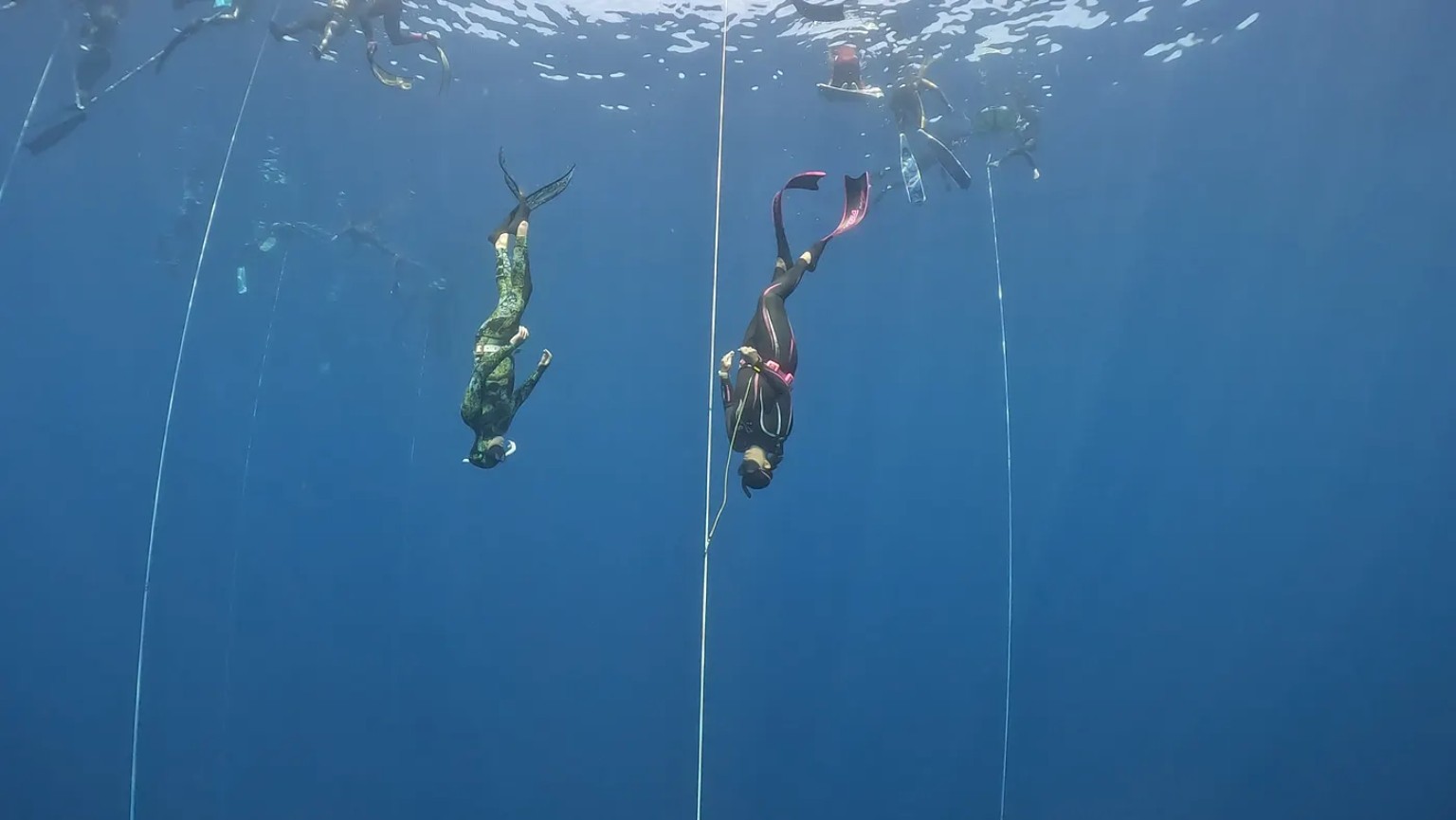
In freediving, safety isn’t optional. You never dive alone. You always have a plan. You dive with a buddy. And in competition settings, you have trained safety divers who meet you on the way back up — descending like quiet angels to make sure you’re not alone. They’re there to track your progress, to support your return, to carry you if needed. Literally to save you if there is a hint of trouble. Their presence is non-negotiable.
As one diver put it:
“Huge emotional benefit from my freediving buddies. Safetying each other builds strong bonds that then greatly improve my mental health.” Participant #91
Now imagine if your relationship to the nervous system worked the same way.
What if your body had a built-in dive buddy?
It does. Your vagus nerve is your internal safety diver. It’s the one that tracks how deep you’ve gone, how long you’ve been holding your breath, and whether it’s safe to come back. It slows your heart rate, guides your breath, and quietly says, I’ve got you.
This is where we begin to redefine safety — not just as protocol or procedure, but as presence. Safety can start to look like this.
- Eat in silence without needing a distraction
- Sit still and feel… safe
- Dive and feel embraced by the water
- Able to rest with ease
- Look at yourself without contorting, performing, or serving
But, let’s define it more clearly. This is where we layer in safety not as a concept, but as a felt sense — a lived experience in the body.
According to the Polyvagal theory, safety means:
“The ability to exist in connection without threat, performance, or collapse.”
For trauma survivors, safety might look like:
- Not having to explain yourself
- Being able to breathe without being watched
- Feeling the ground underneath your feet
- Knowing you can say no and it will be respected
- Being allowed to leave the room without judgment
- Having quiet without needing to fill it
- Knowing that no one is coming to take anything from you
For freedivers, safety can be just as specific:
- No pressure to perform
- A buddy who holds eye contact, not just a protocol
- An instructor who sees the person, not just the technique
- A space where “I need a minute” is sacred
- A dive where breath isn’t rushed, it’s honored
- Where you don’t have to be “ok” but present
- Your dive buddy really has your back, and you see it reflected in their actions.
These are not luxuries. These are the foundations of nervous system recovery.
And safety isn’t just something you name — it’s something you feel. It might feel like stillness you don’t have to earn. It might be the absence of urgency or having to rush. Or the moment you see yourself clearly for the first time in years — without having to contort, conform, fawn, fight, or serve anyone else’s needs. Safety becomes a sensation: the softening of your body, the steadiness in your breath, the way your shoulders drop without asking permission.
One participant in the study called it “a complete reset.” And the data agrees — 75% of participants reported extended states of relaxation through freediving. It’s what happens when being home in your own skin doesn’t feel like a risk. And when you begin to recognize what safety feels like, you can start cultivating it — on land, in water, and in the quiet spaces in between.
From safety, we move to self-regulation. This is where we make lasting changes, not just in our dive, but in our relationship to ourselves and to how we now decide to move forward.
Self-Regulation in Action
Self-regulation isn’t about controlling your feelings — it’s about responding from choice. It doesn’t mean shutting down what’s too much or powering through what feels like too little. It’s the quiet capacity to pause in anger, to soften in the face of overwhelm, and to choose presence even when your instinct is to flee or freeze. It’s the capacity to listen to your nervous system through physical cues, and shift your internal state to meet the moment. It’s the ability to adjust your physiology — not just to survive stress, but to stay present through it. Self-regulation isn’t just a concept — it’s a way of being. And it shows up in the most ordinary ways:
- You notice your breath before your reaction
- Your dives feel more at ease
- Your equalization efforts are smooth and in tune
- You have less jaw tension
- You soften your muscles before you speak
- You feel the edge coming, and you pause
- You use your breath to stay with yourself
It’s the moment you drop into your breathe-up (dive preparation phase), not to perform, but to soften. When your return to the surface feels like a hot knife in butter. That sense of ease and flow in the dive. The kind where you surface with a grin and high-five your buddy.
Or maybe it’s the moment before a difficult conversation, when you pause, feel your feet on the ground, and choose to speak with intention instead of defensiveness. That, too, is self-regulation. It’s the same skill — whether underwater or face-to-face: it’s your system saying, I can stay with this.
It’s when your body knows how to scan for tension, and you listen. You don’t need to think about it — you just respond. Gently. Thoughtfully. Because now you can.
You have space. You have choice. You’re no longer reacting to everything — you’re responding to what matters.
From Reaction to Response
And when you feel yourself drifting, these four questions help you return:
- Do I feel safe right now?
- Where do I feel it in my body?
- What would help me stay connected to myself?
- What’s one small thing I can do to soften?
These aren’t just reflections — they’re anchors. They help you build the internal scaffolding that makes it possible to meet life with presence, not panic.
Here’s how it works:
- Start with the body. Soften your jaw. Wiggle your toes. Ask, “What do I notice?”
- Breathe with intention. Inhale 4, exhale 6. Or match breath with someone safe.
- Anchor into now. Look around. Feel your feet. Hear the moment.
- Notice the shift. A sigh. A softening. A quieter mind.
Even 30 seconds is enough. Come back often.
Self-regulation is how we rewire the message:
From “we’re not safe” to “we can stay.”
From collapse or panic… to choice.
Letting Go of the 20-Year Breath
And maybe for the first time…
You want to be here.
You finally feel ready to sit with your story — not to analyze it, but to live beyond it. You want to soften around the edges, not harden your stance. You want to build peace — not perfection. You want to stay — not because you have to hold it all together, but because nothing’s breaking anymore.
You just want to breathe.
And integration? It’s not some grand arrival. It’s the moment you realize the breath you’ve been holding for 20 years… can finally be released.
That long, held-in exhale — across decades, relationships, over-efforting, and survival — it leaves your body quietly. Not with fireworks. But with presence.
This is the moment when the dive no longer rescues you — it reflects you. It’s no longer about pushing limits, but meeting yourself in the stillness. You kick slower. You soften sooner. You start to trust that presence, not pressure, is what makes the dive feel like home.
As one diver shared:
“The underwater world and the beautiful people that take you there have brought tears of joy to my eyes. A deeper connection socially and physically to this planet.” Participant #57
And another:
“While freediving I am free from the never-ending brain/thoughts & emotions that follow. Learning some of the techniques from freediving during my daily life, I am able to stay more calm and present.” Participant #68
And another:
“It helps to calm my mind and body, even when the day is difficult and hard to focus. If there is no blackout or any other type of failure (on competitions), I always feel more clarity, positiveness, and relaxation after the session.” Participant #75
As one participant said:
“I used to dive to escape. Now I dive to remember who I am.” Participant #1
And another:
“I feel in peace and free. Is like to be in an other world, where no words can hurt me, Is Just myself, the only moment that for me, Is possible to be alone, I mean no object, no music, no people. Just the water.” Participant #34
You want to sit with your story — not to retell it, but to release it. Maybe now, there isn’t anything left to tell. You just want to breathe.
And integration? It feels like the exhale you’ve been holding for 20 years.
Now, you can finally let it go.
That — that — is what a physiology of recovery looks like.
To The Ones Who Stayed
This piece was shaped by the voices of over 120 freedivers — divers who offered their stories, struggles, and transformations with vulnerability and trust. To each of you: thank you for showing us what recovery can look like when it rises from the inside out.
To the reader — if you’ve made it this far, you’ve been holding your own kind of breath. And maybe now, something inside you has softened, too.
This isn’t the end.
It’s just the moment you remember:
You can always come back to your body.
And your body will know the way.
The full book on trauma-informed freediving is in progress — and coming very soon. Thank you for staying with me for this part of our journey together. This was one breath. The next begins now.
Elaine Hicks, LCSW & Freedive Instructor aka theunderwatertherapist
⚠️ Important Disclaimer
This article does not replace formal medical or psychological treatment.
If you are experiencing persistent emotional distress, please seek the support of a licensed therapist or qualified mental health provider.
Never practice breath-holding or freediving alone.
All breath-hold practices, whether in water or on land, should be done with proper training, supervision, and safety protocols in place. Freediving is a powerful tool — but it is not a substitute for professional support, nor is it safe when practiced without guidance.